
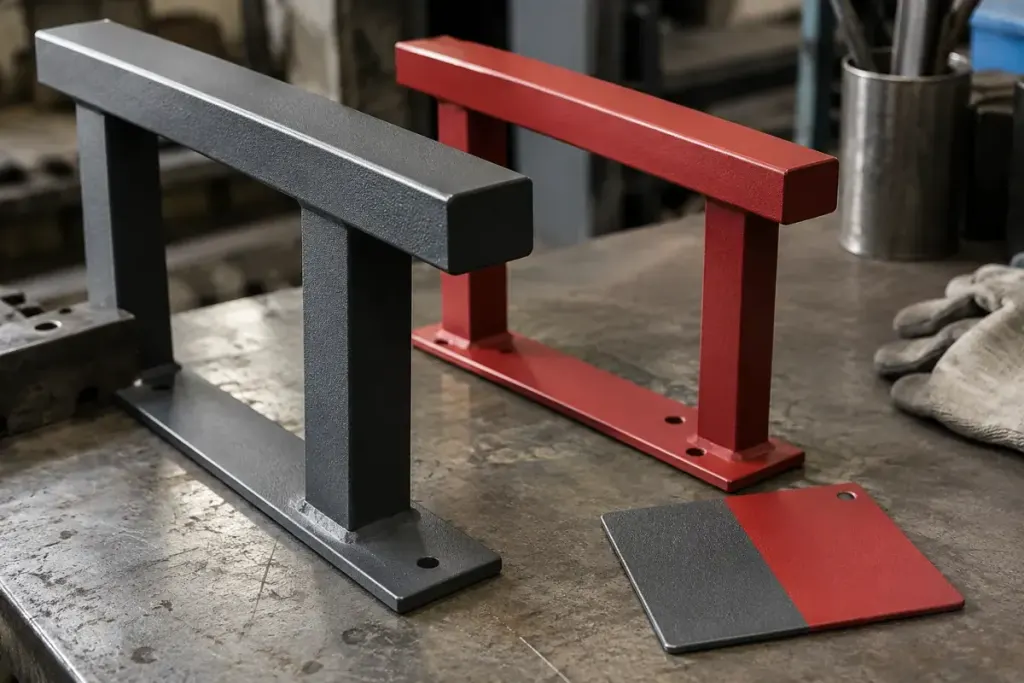
Powder-coated black describes an appearance, but it leaves much of the job unspecified. A sheltered indoor display and a railing near a coast may look similar on delivery while facing very different conditions in service.
Before requesting a finish, describe the part’s environment and purpose. A supplier can respond more usefully to that information than to a colour reference alone.
Start with the substrate and the exposure
Identify the material, the intended location and the conditions the component may encounter. Include moisture, sunlight, cleaning methods, contact with other materials and any relevant handling or wear. Where the part has a structural or safety function, involve the responsible qualified designer; a coating choice does not establish that the component is safe for the application.
The Powder Coating Institute’s technical FAQ explains that coating adhesion depends on factors including substrate cleanliness, pretreatment and proper cure. It also distinguishes powder chemistries with different suitability for outdoor exposure. The word powder-coated does not specify all of those choices.
Ask for the system behind the colour
Request a description of the proposed preparation, coating product and application process appropriate to the job. Ask what information the supplier needs to make that recommendation. A finish sample is useful for appearance, but it is not a substitute for a written description of what will be supplied.
In a hypothetical comparison, Supplier A quotes only a colour and Supplier B identifies the substrate preparation and coating specification. You cannot conclude that B is automatically better, but you can see which missing information makes the quotes difficult to compare. Ask both to respond to the same brief.
Describe the awkward areas
Draw attention to edges, welds, recesses, drainage details, fixing points and areas where coating must not interfere with assembly. Clarify whether threads, mating surfaces or electrical contact points need special treatment. These requirements should be agreed with the fabricator and finisher before production.
For a small prototype batch, consider how you will check fit and appearance before approving the full order. A photograph from a distance may hide the feature most likely to cause trouble during assembly.
Agree what acceptance means
Record the appearance reference, relevant specification, inspection arrangements and any documentation required. If a performance test is proposed, ask what it measures and how the result relates to the intended use. Avoid translating a laboratory test duration into a promised service life without appropriate evidence.
Also ask about maintenance, cleaning and repair guidance for the supplied system. Keep those instructions with the installation records so the next person does not select a cleaning chemical based only on the metal underneath.
A clear brief makes later discussions easier. When a colour, exposure or design detail changes, you can identify which assumption needs review. That is a more useful starting point than discovering after installation that everyone meant something different by a durable finish.
Continue exploring: A Metal-Fabrication Drawing Should Answer These Handover Questions.