

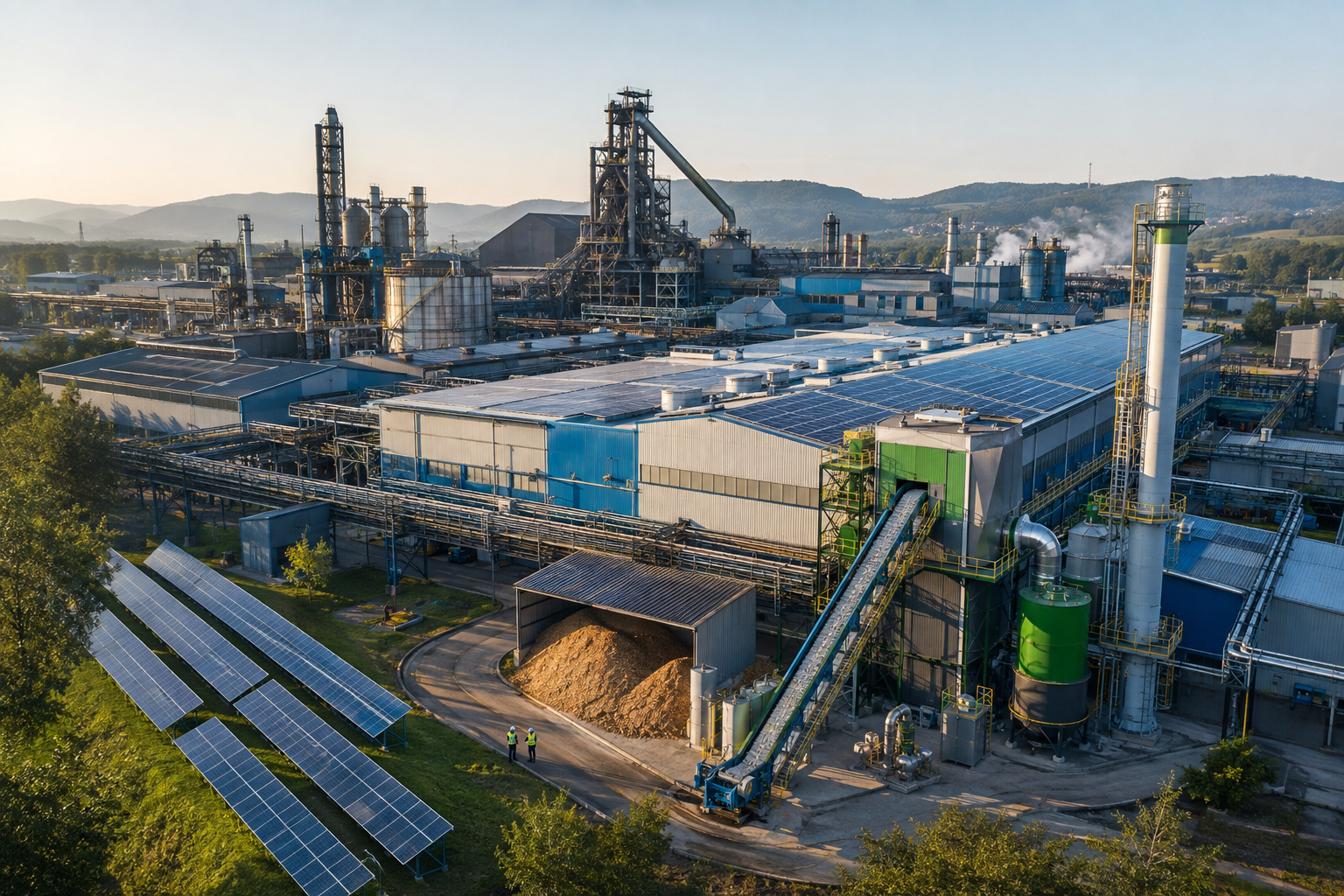
Green Energy Transition: Renewable Energy Solutions for Heavy Industry
Heavy industry is entering a decisive period of transformation. Steel mills, cement plants, chemical facilities, mining operations, and large manufacturing complexes must reduce emissions without sacrificing productivity, product quality, or operational reliability.
This challenge has accelerated the adoption of renewable energy in industry. Solar power, biomass, electrification, energy storage, and intelligent energy-management systems are increasingly integrated into industrial facilities that once depended almost entirely on fossil fuels.
A successful green energy transition is not achieved by installing a single technology. It requires a coordinated strategy that matches renewable resources with production schedules, thermal requirements, available land, raw materials, and existing machinery.
Why Heavy Industry Needs a Green Energy Transition
Heavy manufacturing consumes substantial amounts of electricity and thermal energy. Furnaces, boilers, dryers, kilns, compressors, pumps, and material-handling equipment often operate continuously under demanding conditions.
This high consumption creates both financial and environmental pressure. Fluctuating fuel prices can increase production costs, while carbon emissions may affect regulatory compliance, investor confidence, and access to international markets.
Adopting renewable energy for industrial operations allows manufacturers to reduce their exposure to conventional fuel volatility. It also creates opportunities to improve energy security by generating power or heat directly at the production site.
The transition is particularly important for companies supplying global brands. Many international buyers now evaluate the carbon intensity of their supply chains. Manufacturers that can demonstrate measurable emission reductions may become more competitive.
Understanding Renewable Energy in Industrial Manufacturing
Renewable energy in industry refers to power and heat generated from naturally replenished resources. These resources include sunlight, biomass, wind, hydropower, geothermal energy, and renewable gases.
However, not every energy source is equally suitable for every factory. Solar photovoltaic systems are highly effective for electricity generation, while biomass is often more relevant for industrial heat and steam.
The best configuration depends on the plant’s energy profile. Engineers must identify when energy is consumed, how much is needed, and whether the demand comes from electrical equipment or thermal processes.
A well-designed green industrial energy system may combine several technologies. Solar panels can supply daytime electricity, biomass boilers can generate process heat, and battery storage can stabilize short-term fluctuations.
Solar Panel Efficiency for Large Manufacturing Facilities
Solar photovoltaic panels convert sunlight directly into electricity. For heavy manufacturing, they can be installed on factory roofs, warehouses, parking structures, unused land, or nearby industrial estates.
The practical value of a solar system depends on more than the efficiency rating printed on the panel specification. Orientation, temperature, shading, dust accumulation, inverter performance, cable losses, and maintenance quality all influence actual output.
Module Efficiency and Available Installation Area
Modern commercial solar modules generally offer sufficient efficiency for large industrial installations. Higher-efficiency panels generate more electricity from a limited surface area, making them attractive for factories with restricted roof space.
A large production facility may have extensive roofing, but not every section can support solar equipment. Structural strength, roof age, fire-safety routes, drainage channels, ventilation equipment, and maintenance access must be assessed before installation.
When land is available, ground-mounted systems provide greater flexibility. Panel angles and row spacing can be optimized, while cleaning and inspection become easier.
The objective is not simply to install the greatest number of panels. The system must deliver reliable output without interfering with factory operations.
The Effect of Heat on Solar Performance
Solar panels require sunlight, but excessive heat can reduce their electrical efficiency. Industrial roofs may become extremely hot, especially when made from metal and exposed to direct sunlight for long periods.
Adequate airflow beneath the modules helps release accumulated heat. Proper mounting height and ventilation can therefore improve real-world performance.
Factories should also consider local weather patterns. High irradiation may increase annual generation, but humidity, airborne particles, and seasonal cloud cover can affect output.
Energy projections should use realistic site conditions rather than ideal laboratory results. This produces a more accurate estimate of savings and investment payback.
Dust, Pollution, and Maintenance Requirements
Industrial areas often contain dust, smoke, metal particles, or material residue. These contaminants can accumulate on the surface of solar panels and reduce the amount of sunlight reaching the cells.
Routine inspection and cleaning are essential. The cleaning schedule should be based on local contamination levels, rainfall, water availability, and safety requirements.
Digital monitoring systems can detect unexpected drops in output. If one section of the solar array performs below expectations, technicians can investigate possible shading, dirt accumulation, damaged cables, or inverter faults.
Integrating monitoring into sustainable factory technology helps maintenance teams respond quickly instead of waiting for a major decline in energy production.
Matching Solar Generation with Factory Demand
Solar power is most valuable when electricity is consumed at the same time it is generated. Many factories have strong daytime demand from motors, cooling systems, compressors, processing lines, and ventilation equipment.
This natural alignment can create a high self-consumption rate. Electricity generated on-site is used immediately, reducing the amount purchased from the grid.
Facilities operating around the clock require additional planning. Solar production falls in the evening and stops at night, while industrial loads may remain high.
Battery storage can shift part of the daytime surplus into later operating hours. However, batteries should be sized according to actual load patterns because an oversized system may increase investment costs without providing proportional benefits.
Biomass Efficiency for Heavy Manufacturing
Biomass energy uses organic materials to produce heat, steam, electricity, or renewable fuel. Common industrial feedstocks include wood residue, agricultural waste, palm shells, rice husks, bagasse, sawdust, and selected organic by-products.
For heavy industry, biomass is particularly valuable because many manufacturing processes require thermal energy rather than electricity alone.
A biomass boiler can generate steam for drying, washing, heating, sterilization, material processing, or mechanical power. In certain facilities, biomass can also support combined heat and power generation.
Selecting Consistent Biomass Feedstock
The efficiency of a biomass system depends heavily on fuel quality. Moisture content, particle size, ash content, calorific value, density, and contamination all affect combustion performance.
Wet biomass contains less usable energy because part of the heat must first evaporate the moisture. Inconsistent material can also produce unstable boiler temperatures and inefficient combustion.
Manufacturers need clear feedstock specifications and dependable suppliers. Storage areas must protect the material from rain, excessive humidity, and contamination.
A reliable industrial biomass energy solution should therefore include fuel testing, supplier controls, storage management, and proper material handling—not only the boiler itself.
Improving Boiler and Combustion Efficiency
Efficient biomass combustion requires the correct balance of fuel, air, temperature, and residence time. Insufficient oxygen can cause incomplete combustion, while excessive air carries useful heat out through the exhaust.
Automated combustion controls can adjust fuel feeding and airflow according to boiler demand. Sensors monitor oxygen levels, temperature, steam pressure, and flue-gas conditions.
Heat-recovery equipment can capture energy from exhaust gases and use it to preheat combustion air or boiler feedwater. This reduces the amount of biomass required to produce the same volume of steam.
Insulation is equally important. Poorly insulated pipes, boilers, and steam distribution lines can lose substantial amounts of heat before it reaches the production process.
Managing Ash and Air Emissions
Biomass is renewable, but its use still requires responsible emission control. Combustion can generate ash, dust, nitrogen oxides, carbon monoxide, and other pollutants if the system is poorly designed or operated.
Cyclones, bag filters, electrostatic precipitators, and properly configured combustion controls can reduce particulate emissions. Regular testing is necessary to ensure that the equipment remains effective.
Ash must also be analyzed before reuse or disposal. Depending on the feedstock and production process, it may have potential applications in construction materials, soil improvement, or other industrial products.
This circular approach can support the development of a low-carbon manufacturing facility while reducing waste sent to disposal sites.
Solar Panels Versus Biomass for Industrial Use
Solar panels and biomass serve different industrial needs. Solar photovoltaic technology produces electricity, whereas biomass systems are commonly designed to supply heat and steam.
Solar systems have no fuel cost during operation and contain relatively few moving components. Their output, however, changes according to sunlight availability.
Biomass can provide controllable energy throughout the day if sufficient fuel is available. Its operation requires continuous feedstock procurement, storage, transportation, combustion control, and emission management.
For facilities dominated by electrical loads, solar energy may provide immediate operational savings. For plants with large boilers, dryers, or heating systems, biomass may replace a greater share of fossil fuel consumption.
In many cases, combining both technologies offers the strongest results. Solar panels reduce grid electricity demand during daylight hours, while biomass supplies stable thermal energy for production.
Building a Hybrid Renewable Energy System
A hybrid system integrates multiple energy sources according to the factory’s operational requirements. It can include solar panels, biomass boilers, battery storage, waste-heat recovery, and grid electricity.
The grid may remain necessary for backup and balancing. Renewable energy does not have to replace every conventional energy source immediately to create meaningful benefits.
Manufacturers can begin by targeting the most suitable loads. Administrative buildings, warehouses, lighting systems, cooling equipment, and daytime production lines may be supplied partly by solar power.
Biomass can initially serve one boiler or thermal process before being expanded. This phased approach allows the company to measure performance, train personnel, and refine fuel-management procedures.
A carefully planned hybrid renewable energy strategy also improves resilience. If solar generation declines during cloudy conditions, biomass or the grid can support essential operations.
Energy Efficiency Must Come Before Capacity Expansion
Renewable energy investments deliver better results when the factory is already energy efficient. Otherwise, new generation capacity may simply power avoidable losses.
An energy audit can identify inefficient motors, compressed-air leaks, excessive boiler blowdown, heat loss, poor insulation, outdated lighting, and equipment operating without productive demand.
Variable-speed drives can reduce electricity consumption in pumps and fans. High-efficiency motors can lower baseline loads, while automated shutdown controls prevent equipment from running unnecessarily.
Waste heat from furnaces, kilns, compressors, and exhaust systems may also be recovered for preheating, drying, or hot-water production.
Reducing demand first allows the company to install a smaller renewable system. This lowers capital requirements and can improve the financial return of the project.
The Role of Digital Monitoring and Energy Management
Industrial decarbonization depends on accurate information. Smart meters and energy-management platforms can track consumption by production line, machine, building, or operating shift.
This visibility helps managers identify energy-intensive processes and compare renewable generation with actual demand. It also reveals unusual consumption that may indicate equipment damage or poor operating practices.
Predictive systems can use production schedules, weather forecasts, fuel availability, and historical consumption to determine the most efficient energy mix.
Digital controls are especially useful in a smart environmentally friendly factory because renewable energy production and industrial demand must be continuously balanced.
Performance indicators should include more than total electricity generation. Companies should monitor self-consumption, fuel savings, renewable-energy share, equipment availability, thermal efficiency, emissions avoided, and energy use per unit of product.
Financial and Operational Challenges
The initial investment remains one of the main barriers to renewable energy adoption. Solar structures, inverters, electrical protection, biomass boilers, storage systems, and emission controls can require substantial capital.
Nevertheless, evaluating only the purchase price creates an incomplete picture. Manufacturers should consider fuel savings, maintenance expenses, equipment lifetime, production reliability, financing costs, and potential carbon-related obligations.
Biomass projects also face supply-chain risks. Feedstock prices and availability may change due to weather, competing demand, transportation constraints, or seasonal harvest patterns.
Solar projects require careful structural and electrical integration. Weak roofs, insufficient transformer capacity, and outdated protection systems can increase project complexity.
A comprehensive feasibility study should evaluate these risks before procurement begins.
Practical Steps Toward a Greener Heavy Industry
The transition should begin with detailed energy mapping. Manufacturers need to understand how much electricity, steam, and process heat each production area consumes.
The next step is to reduce unnecessary demand through maintenance, equipment upgrades, insulation, and process optimization.
After efficiency improvements, engineers can assess the available roof area, solar irradiation, biomass supply, storage capacity, and connection infrastructure.
Pilot projects are valuable for testing technical assumptions. A smaller installation can reveal maintenance requirements, workforce capabilities, fuel characteristics, and operational challenges before large-scale expansion.
Employee training must be included from the beginning. Operators, technicians, safety personnel, and production managers need clear procedures for renewable equipment and emergency conditions.
Finally, every project should have measurable targets. The company must define expected energy savings, emission reductions, renewable contribution, and payback period.
Toward Competitive and Environmentally Friendly Manufacturing
The green energy transition is becoming a strategic requirement for heavy industry. It can reduce operating risks, strengthen energy security, and support access to markets that prioritize low-carbon products.
Solar panels are highly effective for reducing daytime electricity purchases, especially when industrial demand follows predictable working hours. Biomass can provide stable heat and steam for processes that are difficult to electrify.
Neither technology delivers maximum value without proper engineering. System sizing, fuel quality, maintenance, digital monitoring, energy efficiency, and operational discipline determine the real outcome.
By developing clean energy solutions for heavy manufacturing, companies can move beyond symbolic environmental initiatives. They can build productive, resilient, and commercially viable industrial operations prepared for a lower-carbon economy.