

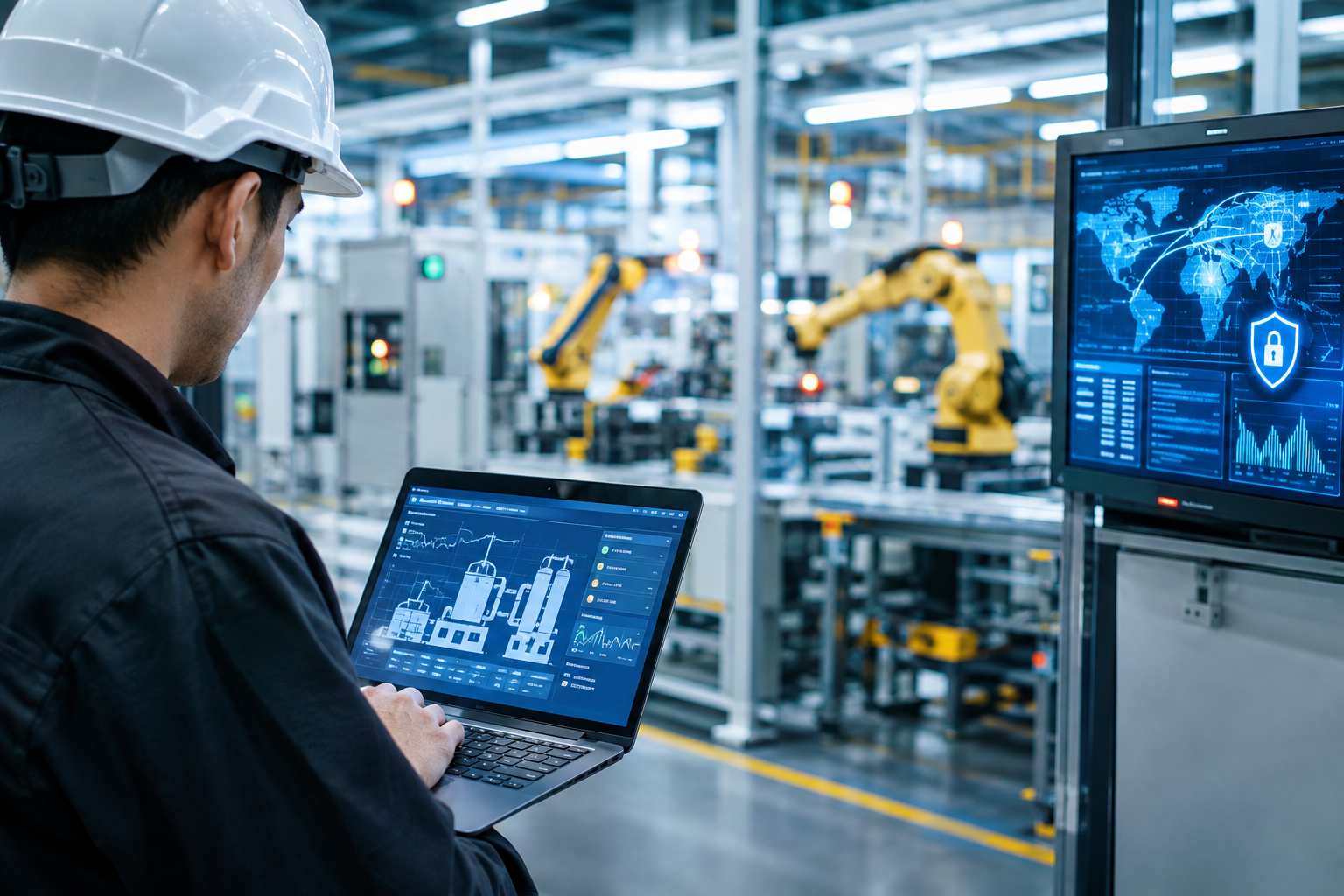
Why Cybersecurity in Industrial Control Systems (ICS) is More Critical Than Ever
Why Cybersecurity in Industrial Control Systems (ICS) is More Critical Than Ever
Industrial facilities are becoming more connected, automated, and data-driven than ever before. Manufacturing plants, energy facilities, water treatment systems, logistics centers, and other critical operations increasingly depend on digital technologies to monitor equipment and control physical processes.
This transformation creates major opportunities for efficiency, but it also introduces new cybersecurity risks. Systems that were once isolated can now communicate with corporate networks, cloud platforms, remote-access tools, and connected devices.
As a result, industrial cybersecurity has become an essential part of modern industrial operations. Protecting operational technology is no longer simply an IT concern. A successful cyberattack can disrupt production, damage equipment, compromise worker safety, and create significant financial losses.
The Growing Importance of Industrial Cybersecurity
Industrial Control Systems (ICS) are responsible for monitoring and controlling physical processes. They can include programmable logic controllers (PLCs), distributed control systems (DCS), supervisory control and data acquisition (SCADA) platforms, sensors, human-machine interfaces, and industrial communication networks.
Historically, many ICS environments were designed with reliability and availability as their primary priorities. Cybersecurity was often considered secondary because these systems operated within isolated networks.
Modern industrial environments are very different.
Manufacturers now connect production equipment to enterprise systems, analytics platforms, remote monitoring applications, and cloud services. This connectivity allows organizations to collect valuable operational data and improve decision-making.
However, every additional connection can introduce another potential entry point for attackers.
Effective ICS protection therefore requires organizations to consider cybersecurity throughout the entire industrial environment rather than focusing on individual computers or network devices.
Cyberattacks Can Affect Physical Operations
One of the defining characteristics of industrial cybersecurity is the connection between digital systems and physical processes.
In a conventional IT environment, a cyberattack might result in stolen information, locked files, or unavailable applications. In an industrial environment, compromised systems may influence machinery, production lines, valves, motors, temperature controls, or other physical processes.
This creates a much broader risk profile.
A compromised control system could potentially interrupt production, cause equipment to operate incorrectly, or force an organization to shut down operations while the incident is investigated.
For industries where continuous production is essential, even a short interruption can have serious consequences.
Understanding Vulnerabilities in Connected SCADA Systems
SCADA systems are widely used to monitor and control industrial processes. They provide operators with visibility into equipment and allow commands to be sent across industrial networks.
The increasing connectivity of SCADA environments has made them more flexible, but it has also expanded their attack surface.
Legacy Technology Creates Security Challenges
Many industrial facilities operate equipment that was installed years or even decades ago. Replacing legacy systems can be expensive, technically complicated, and disruptive to production.
Some older industrial devices were never designed to operate in an environment where they could be exposed to modern network threats.
They may lack advanced authentication, encryption, secure update mechanisms, or modern security monitoring capabilities.
Organizations must therefore find practical ways to protect legacy equipment without compromising operational reliability.
Network segmentation, access controls, continuous monitoring, and carefully managed security gateways can help reduce exposure while allowing older equipment to remain operational.
Remote Access Can Expand the Attack Surface
Remote connectivity is another important consideration.
Engineers, maintenance teams, system integrators, and vendors may require remote access to industrial environments for troubleshooting and maintenance. While remote access can reduce downtime and improve response times, poorly configured connections can create significant security weaknesses.
An attacker who compromises a remote-access account may attempt to move from an external environment into sensitive industrial networks.
Strong authentication, limited privileges, controlled access windows, network segmentation, and detailed activity monitoring can help reduce these risks.
Connected Devices Increase Complexity
Industrial facilities increasingly rely on sensors, smart controllers, industrial gateways, cameras, and other connected devices.
Each device can contribute to the overall attack surface.
This is especially relevant as manufacturers adopt Industrial Internet of Things (IIoT) technologies. More connected devices can produce better visibility and automation, but they also require consistent security management.
Organizations need to understand what devices are connected, what information they exchange, which systems they communicate with, and how those connections are protected.
Why Smart Factory Security Matters
The rise of Industry 4.0 is transforming traditional manufacturing into highly connected production environments.
Smart factories use automation, robotics, sensors, artificial intelligence, analytics, and real-time communication to improve productivity.
This creates enormous operational advantages, but it also makes smart factory security increasingly important.
A smart factory may contain hundreds or thousands of connected assets. If security is not incorporated into the architecture from the beginning, a vulnerability in one component could potentially create opportunities for attacks against other systems.
Security Must Extend Beyond the IT Department
Traditional cybersecurity programs often focus heavily on corporate computers, servers, applications, and data.
Industrial environments require a broader approach.
IT and operational technology (OT) teams need to collaborate because the consequences of security decisions can be very different in a production environment.
For example, immediately applying a software update may be considered normal in an office environment. In a manufacturing plant, however, changing software on a critical control system without proper testing could affect production stability.
Industrial cybersecurity must therefore balance security with availability, safety, reliability, and operational requirements.
Building a Strong ICS Protection Strategy
A comprehensive security strategy begins with visibility.
Organizations need an accurate understanding of their industrial assets, network architecture, communication paths, and potential vulnerabilities. Without this visibility, security teams may struggle to identify abnormal behavior or determine which systems require urgent attention.
Segment Industrial Networks
Network segmentation is one of the most effective ways to reduce the potential impact of a cyberattack.
Industrial systems should not automatically have unrestricted communication with corporate networks or the public internet.
Separating critical control environments into appropriate security zones can limit an attacker’s ability to move laterally after gaining access to one system.
Segmentation should be designed according to the operational architecture and communication requirements of the facility.
Strengthen Identity and Access Controls
Not every employee, contractor, or vendor should have the same level of access to industrial systems.
Organizations can reduce risk by applying least-privilege principles and ensuring that users receive only the permissions required for their responsibilities.
Multi-factor authentication can provide an additional layer of protection for remote and privileged access where technically feasible.
Access credentials should also be reviewed regularly, particularly when employees change roles or external vendors no longer require access.
Monitor Industrial Network Activity
Prevention alone is not enough.
Security teams should continuously monitor industrial networks for unusual activity, unexpected connections, unauthorized commands, and other indicators of potential compromise.
Behavior-based monitoring can be particularly valuable because industrial environments often have relatively predictable communication patterns.
An unexpected change in those patterns may deserve investigation.
Cybersecurity Should Be Part of Industrial Design
Security is most effective when it is considered during system design rather than added after deployment.
When new automation systems, connected sensors, cloud platforms, or production technologies are introduced, cybersecurity requirements should be evaluated alongside performance and operational requirements.
This approach can help organizations avoid creating unnecessary vulnerabilities as their facilities become more connected.
Security should also extend to suppliers and technology partners. Industrial organizations depend on many third parties for hardware, software, maintenance, engineering, and remote services.
Understanding how these external relationships interact with critical systems is an important part of reducing supply-chain risk.
Preparing for the Future of Industrial Cybersecurity
Industrial environments will continue to become more connected.
Artificial intelligence, digital twins, advanced robotics, predictive maintenance, edge computing, and IIoT technologies are likely to increase the amount of data flowing between machines, industrial networks, enterprise platforms, and external services.
These technologies can make factories more productive and responsive, but they also create new cybersecurity considerations.
Organizations that treat security as an afterthought may find it increasingly difficult to protect complex industrial environments.
By contrast, companies that integrate industrial cybersecurity into their digital transformation strategies can build stronger foundations for long-term growth.
Modern ICS protection should combine asset visibility, network segmentation, access management, monitoring, vulnerability management, incident response, and employee awareness.
At the same time, effective smart factory security must recognize that industrial systems have unique operational requirements that cannot always be addressed using conventional IT security methods.
The Future Depends on Secure Industrial Connectivity
Connectivity is becoming a defining feature of modern industry. It enables manufacturers and infrastructure operators to make faster decisions, automate processes, improve efficiency, and respond to changing conditions.
But greater connectivity also means greater responsibility.
Protecting industrial control systems requires organizations to understand how digital threats can affect physical operations and to build security into every layer of the industrial environment.
The goal is not to prevent connectivity. It is to make connectivity safer.
As industrial automation continues to evolve, cybersecurity will increasingly become a fundamental component of operational resilience. Companies that invest in strong protection today will be better positioned to embrace new technologies while keeping production systems reliable, secure, and ready for the future.