

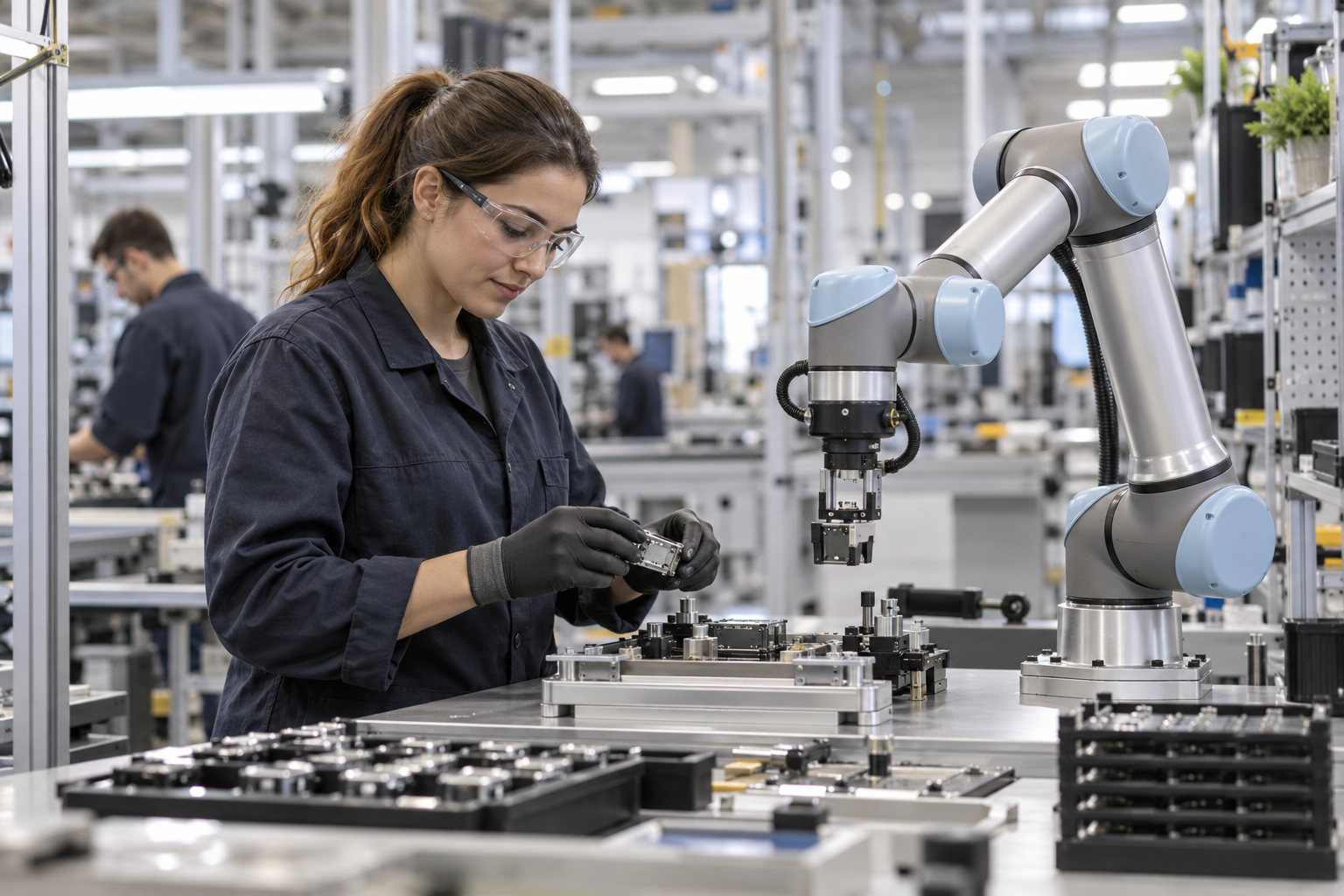
The Growing Role of Collaborative Robots (Cobots) in Modern Factories
Modern factories are under constant pressure to increase productivity, maintain consistent quality, and respond quickly to changing customer demand. Collaborative robots, commonly known as cobots, are helping manufacturers meet these challenges by working alongside people in shared production environments.
Unlike traditional industrial robots that usually operate behind fixed safety barriers, cobots are designed for closer interaction with human workers. Their compact size, flexible programming, and integrated safety functions make them suitable for businesses seeking practical automation without completely redesigning their facilities.
What Are Collaborative Robots?
Collaborative robots are programmable robotic systems developed to assist people with repetitive, physically demanding, or precision-based tasks. They can handle components, operate tools, inspect products, package goods, and support many other production activities.
The growing adoption of collaborative robots in manufacturing reflects an important change in industrial strategy. Instead of viewing robots only as replacements for manual labor, manufacturers increasingly use them as tools that extend human capabilities.
Workers continue to provide judgment, adaptability, creativity, and process knowledge. Cobots contribute repeatability, accuracy, and endurance. Combining these strengths can create a more productive and resilient manufacturing operation.
How Cobots Differ from Traditional Industrial Robots
Traditional industrial robots are commonly built for high-speed, high-volume production. They may lift heavy materials, weld vehicle frames, or perform rapid movements that make physical separation from workers necessary.
Cobots are generally smaller, lighter, and easier to deploy. Many models can be mounted on mobile platforms or moved between workstations as production requirements change.
They are also designed with safety-focused technologies such as force limitation, speed monitoring, and automatic stopping. These features can enable closer cooperation with people when the application has been properly assessed and configured.
Flexible Deployment
A conventional robotic cell may require extensive guarding, fixed tooling, and significant engineering work. A cobot installation can often be integrated into an existing workstation with fewer structural changes.
This flexibility supports manufacturers that produce several product variants or operate in smaller batches. A cobot can perform machine tending during one shift and assist with packaging or inspection during another.
The adaptability of flexible industrial automation can help factories respond more efficiently to seasonal demand, product updates, and shorter production cycles.
Accessible Programming
Many cobots include graphical programming interfaces and guided teaching functions. Operators may be able to move the robotic arm manually to selected positions and save those movements as part of a task sequence.
This does not eliminate the need for technical knowledge. However, it can reduce the programming barrier for straightforward applications and allow trained production teams to make approved adjustments more efficiently.
Why Modern Factories Are Adopting Cobots
Manufacturers are turning to cobots for more than labor savings. These systems can address several operational problems simultaneously, including worker fatigue, inconsistent processes, skills shortages, and limited floor space.
Cobots can also provide a more gradual path toward automation. A factory does not necessarily need to automate an entire production line at once. It can begin with one carefully selected process and expand after measuring the results.
Improving Productivity
Cobots can perform repetitive motions with consistent timing throughout a production shift. They do not experience physical fatigue in the same way people do, making them useful for predictable tasks with clearly defined movements.
When a cobot handles repetitive loading, unloading, or positioning, workers can focus on activities that require decision-making and problem-solving. This division of responsibilities can improve total workstation output without removing human involvement.
A well-planned factory automation strategy should examine the performance of the complete process rather than focusing only on the robot’s operating speed. Material availability, machine cycle time, operator movement, and quality requirements all influence the final result.
Supporting Labor-Challenged Operations
Many factories struggle to recruit and retain employees for monotonous or physically demanding roles. Cobots can reduce the burden of these tasks while allowing experienced workers to remain involved in production.
For example, a cobot can repeatedly place unfinished parts into a machine while the operator supervises several stations, handles exceptions, and checks product quality. This arrangement uses automation to support the workforce rather than simply reducing headcount.
Increasing Production Consistency
Repetitive manual processes may vary because of fatigue, distraction, or differences in technique. Cobots can repeat programmed movements with dependable position control.
This consistency is valuable for applications such as adhesive dispensing, screwdriving, polishing, and component placement. Stable movement can reduce process variation, rework, and unnecessary material use.
Human-Machine Collaboration in Practice
Effective human-machine collaboration does not mean placing a robot beside a worker and expecting immediate improvement. The workstation must be designed around clear responsibilities, predictable interactions, and safe working methods.
The strongest applications assign each part of the process to the resource best suited to perform it. The cobot handles repeatable physical actions, while the worker manages inspection, preparation, adjustment, and unexpected conditions.
Shared Workspaces
Some collaborative applications allow a person and cobot to use the same general work area. Their activities may occur simultaneously or at different stages of the production cycle.
For example, an operator may prepare components on one side of a fixture while the cobot assembles parts on the other side. The process should be arranged to minimize unnecessary crossing of movement paths.
Clear workstation organization improves both safety and efficiency. Parts, tools, and controls should be positioned so operators can work comfortably without reaching through the robot’s expected movement area.
Complementary Skills
People are particularly effective at recognizing unusual conditions, interpreting complex visual information, and adapting to product variation. Cobots are effective at repeating defined movements and maintaining controlled force or position.
A successful human-robot collaboration system combines these abilities. The goal is not to make the person behave like a machine, but to use automation where repeatability provides the greatest benefit.
Worker Acceptance and Training
Employees should understand why a cobot is being introduced, what tasks it will perform, and how their own responsibilities may change. Early involvement can help identify practical concerns that may not appear during an engineering review.
Training should cover normal operation, safe interaction, fault recognition, emergency procedures, and approved methods for resetting the equipment. Operators should also know which adjustments they are authorized to make.
When workers feel confident around the technology, they are more likely to contribute ideas that improve the process.
Safety Considerations for Collaborative Robot Applications
A cobot may include collaborative safety functions, but this does not automatically make every cobot application safe. The complete system must be evaluated, including the end-of-arm tool, payload, fixtures, nearby equipment, and possible contact points.
A lightweight robot holding a sharp component can still create a serious hazard. Similarly, a slow-moving arm may trap a hand against a fixed surface if the workstation has not been designed carefully.
Risk Assessment Comes First
Every application should begin with a detailed risk assessment. Engineers need to identify potential crushing, impact, entanglement, electrical, thermal, and process-related hazards.
The assessment must consider normal production, setup, maintenance, cleaning, troubleshooting, and foreseeable misuse. Risk reduction measures can then be selected according to the actual operating conditions.
Installing safe robotic manufacturing solutions requires attention to the entire work cell rather than relying only on the robot manufacturer’s built-in features.
Power and Force Limiting
Power and force limiting is a common collaborative operating method. The robot is designed and configured to restrict the forces that could occur during contact.
Its effectiveness depends on several factors, including robot speed, payload weight, tool shape, contact location, and the surrounding structure. Appropriate testing may be needed to confirm that the configured system remains within acceptable limits.
Speed and Separation Monitoring
In some applications, sensors detect the distance between a person and the robot. The system can reduce speed as the worker approaches and stop before the separation distance becomes too small.
This method may support applications that require higher speed when people are not nearby. However, sensor coverage, stopping distance, approach direction, and possible blind spots must be evaluated carefully.
Hand-Guided Operation
Certain cobots can be controlled through hand-guided movement. An operator uses a dedicated control device to guide the robot while the system manages its motion.
This function can be useful for teaching positions, handling heavy components, or performing tasks that benefit from direct human control. Proper enabling devices and operating procedures are still necessary.
Common Cobot Applications in Factories
Cobots can support a wide range of production processes. The best starting applications usually have stable inputs, repeatable motions, and measurable performance targets.
Machine Tending
Machine tending is one of the most common uses for cobots. The robot can load parts into CNC machines, presses, testing equipment, or other production assets.
It can also remove completed parts and place them in trays or inspection stations. Automating this repetitive cycle can reduce operator waiting time and support more consistent machine utilization.
Assembly and Fastening
Cobots can position components, insert parts, tighten screws, and assist with controlled assembly operations. Integrated torque tools can provide process data for quality monitoring.
Workers can handle flexible materials or complex alignment while the cobot performs the repeatable fastening sequence. This creates a balanced workflow that benefits from both human dexterity and robotic consistency.
Quality Inspection
When equipped with cameras, sensors, or measurement tools, cobots can present parts for inspection or move inspection devices around a product.
They may check dimensions, surface conditions, labels, component presence, or assembly completeness. Consistent inspection paths can improve traceability and reduce the chance that important areas are missed.
Packaging and Palletizing
End-of-line operations often include repeated lifting, rotation, and placement. These motions can contribute to physical strain when performed throughout a long shift.
Cobots can pack products into cartons, arrange items in trays, apply labels, and stack boxes. Compact palletizing systems are particularly useful in facilities where floor space is limited.
Cobots Industry Trends Shaping Future Adoption
Current cobots industry trends show that collaborative automation is becoming more capable, connected, and application-focused. Manufacturers increasingly expect complete solutions rather than a robotic arm that requires extensive custom engineering.
Advances in vision systems, gripping technology, artificial intelligence, and software integration are expanding the range of tasks cobots can perform.
Smarter Vision and Sensing
Improved machine vision allows cobots to locate parts that are not perfectly aligned. This can reduce the need for complex fixtures and make automated systems more tolerant of normal production variation.
Force-torque sensing also enables more controlled interaction with components. Cobots can use this feedback for polishing, surface finishing, insertion, and delicate assembly.
Mobile Collaborative Robots
Combining a cobot arm with an autonomous mobile platform allows one system to move between different work areas. It may transport materials, tend machines, and support inspection tasks across a facility.
Mobile manipulation introduces additional navigation and safety challenges, but it also creates opportunities for more responsive material flow.
Data-Connected Automation
Modern cobots can exchange information with machines, production software, and quality systems. This connectivity supports performance monitoring, maintenance planning, and process traceability.
The value of connected manufacturing technology extends beyond physical automation. Operational data can reveal cycle-time losses, repeated faults, and opportunities for continuous improvement.
Application-Specific Packages
Cobot suppliers and integrators increasingly offer packages designed for welding, palletizing, sanding, machine tending, and other defined applications.
These packages may include the robot, tooling, software, safety components, and setup guidance. Standardized solutions can reduce deployment time, although every factory must still assess its specific products and working environment.
How to Select the Right Cobot Application
Not every manual process is a good automation candidate. A suitable application should provide clear operational benefits and be stable enough to automate reliably.
Manufacturers should examine task repetition, payload, reach, cycle time, part presentation, environmental conditions, and required precision. They should also consider how frequently the product or process changes.
Start with a Defined Problem
A cobot project should begin with a production problem rather than with the technology itself. The goal might be to reduce ergonomic risk, increase machine utilization, improve consistency, or address staffing limitations.
Clear objectives make it easier to choose the appropriate equipment and evaluate whether the project has succeeded.
Calculate the Complete Investment
The robot arm is only one part of the total system. The investment may also include grippers, sensors, fixtures, safety devices, engineering, programming, training, and maintenance.
Expected benefits should be based on realistic production conditions. Downtime, product changeovers, operator involvement, and material handling must be included in the calculation.
Plan for Future Changes
A flexible cobot cell can provide greater long-term value if it can accommodate new products or additional processes. Modular tooling, adjustable fixtures, and reusable software can make redeployment easier.
However, excessive flexibility can increase cost and complexity. The system should provide enough adaptability for realistic production needs without compromising reliability.
Challenges That Manufacturers Must Address
Cobots offer important advantages, but successful implementation still requires careful engineering. Poor part presentation, inconsistent materials, unstable processes, or unrealistic cycle-time expectations can limit performance.
Integration with older machines may also require additional controls or communication hardware. In some cases, the cobot itself is straightforward, while the surrounding equipment creates most of the technical difficulty.
Another challenge is maintaining internal capability. Factories need trained personnel who can support routine operation, recognize problems, and coordinate with integrators when more advanced changes are required.
The Future of Factory Automation Is Collaborative
Cobots are helping manufacturers adopt automation in areas that were previously difficult to justify. Their compact design, adaptable programming, and collaborative functions make them especially valuable for mixed production environments.
Their greatest contribution may be the way they reshape the relationship between people and machines. Workers can move away from repetitive physical tasks and concentrate on supervision, quality, optimization, and problem-solving.
As sensing, software, and end-of-arm tooling continue to improve, cobots will become more versatile. Even so, technology alone will not guarantee success. Careful application selection, thorough risk assessment, employee training, and ongoing performance evaluation will remain essential.
The expanding role of modern factory automation therefore represents more than the installation of new robots. It reflects a broader manufacturing model in which human knowledge and robotic consistency work together to create safer, more flexible, and more competitive factories.