

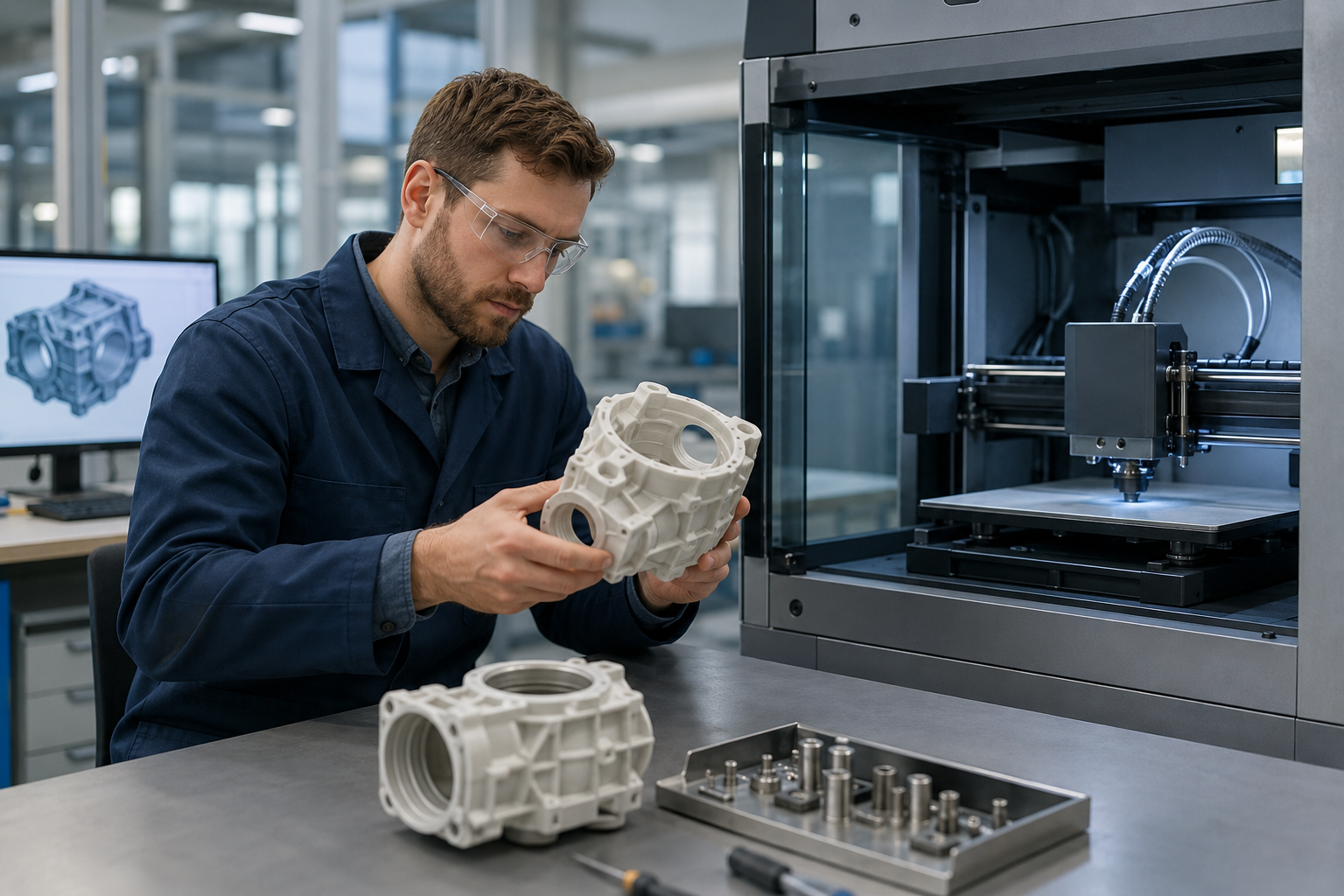
How 3D Printing Is Revolutionizing Rapid Prototyping in Manufacturing
Manufacturers have traditionally relied on machining, molding, and manual fabrication to transform product ideas into physical prototypes. Although these methods remain valuable, they can require expensive tooling, lengthy setup procedures, and multiple production stages.
Three-dimensional printing changes this process by building components directly from digital models. Engineers can now design, produce, test, and improve functional parts in a fraction of the time required by many conventional methods.
This faster development cycle is transforming how manufacturers solve engineering problems, evaluate new concepts, and prepare products for commercial production.
Understanding 3D Printing and Additive Manufacturing
Three-dimensional printing is an additive manufacturing process in which material is deposited, fused, or solidified layer by layer. The machine follows instructions from a digital three-dimensional model until the complete object is formed.
This approach differs significantly from subtractive manufacturing. Machining processes usually begin with a solid block and remove material through cutting, drilling, or grinding. Additive systems place material only where the component requires it.
Modern 3D printing in manufacturing can process engineering polymers, composite materials, resins, ceramics, and several industrial metals. This versatility allows manufacturers to produce everything from visual concept models to functional components suitable for demanding tests.
From CAD Model to Physical Prototype
The process begins with a computer-aided design model. Engineers convert the model into a printable file, position the component within the machine’s build area, and select the appropriate material and processing parameters.
Specialized software divides the digital model into thin horizontal layers. The printer then constructs those layers sequentially.
Once printing is complete, the prototype may undergo post-processing. Depending on the technology, this can include removing support structures, cleaning surfaces, curing resin, applying heat treatment, machining critical features, or adding a protective finish.
Why Rapid Prototyping Matters in Manufacturing
Prototyping allows engineering teams to evaluate a design before investing in large-scale production. A physical model can reveal assembly conflicts, poor ergonomics, weak structures, or manufacturing difficulties that may not be obvious on a computer screen.
Traditional prototype production can take days or weeks, especially when it involves external suppliers or custom tooling. Additive manufacturing compresses this timeline by allowing companies to produce components directly from digital files.
With advanced rapid prototyping technology, an engineer can modify a design in the afternoon, start a print before leaving the facility, and inspect the revised component the following morning.
Faster Design Iterations
Successful product development rarely depends on a single design. Engineers usually create several versions before reaching a configuration that meets technical, commercial, and user requirements.
Three-dimensional printing makes these iterations faster and more affordable. Instead of waiting for a machine shop to manufacture every revision, development teams can print multiple versions and compare them directly.
This encourages experimentation. Engineers can evaluate different wall thicknesses, connection mechanisms, internal structures, and component shapes without creating dedicated tooling for every alternative.
Earlier Detection of Design Problems
Finding an error during the prototype stage is considerably less expensive than discovering it after mass production begins.
A printed prototype can help teams identify incorrect dimensions, restricted tool access, insufficient clearances, or incompatible assembly points. Designers can then correct the digital model before ordering production equipment or releasing final specifications.
This early validation is one of the most important additive manufacturing benefits because it reduces the financial and operational consequences of late engineering changes.
Eliminating the Need for Prototype Tooling
Conventional manufacturing processes often depend on molds, dies, fixtures, and specialized cutting tools. These resources can be expensive and time-consuming to produce, particularly when only one or two prototype components are needed.
Three-dimensional printing can create low-volume parts without dedicated tooling. This capability reduces initial costs and removes one of the largest delays in traditional prototype development.
Toolless production also enables manufacturers to test more concepts within the same development budget. Resources that would have been spent on temporary molds can instead support additional design iterations, material trials, or performance testing.
Improving Development Flexibility
Digital production gives engineering teams greater freedom to respond to changing requirements. If a customer requests a revised connection point or a test identifies an undersized feature, the design can be updated without replacing expensive prototype tooling.
This flexibility supports industrial product development in sectors where products must be customized or frequently improved. It is especially valuable for specialized machinery, medical devices, automotive components, robotics, and low-volume industrial equipment.
Reducing Material Waste
Waste reduction is one of the clearest advantages of additive manufacturing. Because the printer builds a component layer by layer, it generally uses material more selectively than processes that remove large amounts from a solid workpiece.
Subtractive manufacturing may convert a substantial portion of the original material into chips or offcuts. Additive manufacturing can significantly reduce this waste, particularly when producing complex components from high-value materials.
However, waste is not eliminated completely. Failed prints, support structures, powders, test pieces, and post-processing residues must still be managed. Efficient machine settings and responsible material recovery procedures remain essential.
Designing Lightweight Components
Additive manufacturing also reduces material use through design optimization. Engineers can create internal lattices, hollow sections, and topology-optimized structures that maintain strength while removing unnecessary mass.
These geometries are often difficult or impossible to manufacture using conventional cutting tools. Three-dimensional printing can produce them as integrated features without requiring additional assembly operations.
Lighter components may improve machine efficiency, reduce transportation weight, and lower material consumption. For moving equipment, reduced mass can also decrease inertia and energy demand.
Consolidating Multiple Parts
A traditional assembly may contain several brackets, fasteners, connectors, and structural elements because each component must be manufactured separately. Additive manufacturing can sometimes combine these pieces into one optimized part.
Part consolidation reduces assembly labor, minimizes inventory requirements, and eliminates potential failure points at joints. It can also lower waste by reducing the number of individual production processes required.
This capability makes sustainable manufacturing solutions increasingly relevant to companies seeking both operational efficiency and responsible resource use.
Creating Complex Geometries More Easily
Traditional tools must physically reach the surface being cut. This requirement limits the types of internal channels, curved passages, and enclosed structures that conventional machines can produce.
Additive manufacturing builds geometry progressively, giving engineers far more freedom. Components can include conformal cooling channels, internal fluid paths, organic shapes, and intricate lattice structures.
Design freedom does not mean every shape should be printed without careful evaluation. Engineers still need to consider build orientation, support requirements, surface quality, dimensional tolerance, and post-processing access.
Supporting Design for Additive Manufacturing
Design for additive manufacturing is a specialized engineering approach that considers the strengths and limitations of the printing process from the beginning.
Rather than using a design originally created for machining, engineers optimize the part for layer-based production. They may adjust overhangs, redistribute material, reduce support structures, or combine multiple components.
Proper design preparation improves print reliability and helps manufacturers gain the full value of advanced manufacturing engineering instead of treating the printer as a direct replacement for every conventional machine.
Expanding Functional Testing Capabilities
Early three-dimensional printers were primarily associated with visual models. Today, industrial systems can produce prototypes with mechanical, thermal, and chemical properties suitable for functional evaluation.
Manufacturers can test whether a printed part fits correctly, supports a specified load, survives repeated movement, or interacts properly with other components. Engineers can also use prototypes for airflow studies, fluid testing, assembly validation, and ergonomic assessments.
Material selection is critical. A visually accurate polymer model may not replicate the performance of the final metal component. Test objectives should therefore determine the printing process and material rather than appearance alone.
Producing Jigs, Fixtures, and Testing Aids
The technology is not limited to product prototypes. Manufacturers frequently use it to produce assembly jigs, inspection fixtures, drill guides, protective covers, and custom handling tools.
These items can improve repeatability and make production tasks safer or more comfortable. Because they are manufactured digitally, fixtures can be customized for a particular operator, machine, or product variation.
Rapid production of supporting tools helps connect prototype development with practical manufacturing process improvement across the factory floor.
Strengthening Collaboration Between Teams
A physical prototype creates a shared reference for designers, engineers, production specialists, customers, and decision-makers. Stakeholders can hold the component, examine its proportions, and provide specific feedback.
This reduces misunderstandings that may arise when teams rely exclusively on drawings or digital renderings. Manufacturing personnel can also evaluate whether the proposed design will be practical to assemble, inspect, maintain, and repair.
Faster feedback leads to better decisions. It allows technical and commercial concerns to be considered before the design becomes difficult or expensive to modify.
Integrating 3D Printing with Conventional Production
Three-dimensional printing is not expected to replace every manufacturing process. Injection molding remains highly efficient for large quantities of plastic parts, while CNC machining provides excellent accuracy and surface quality for many components.
The strongest production strategies combine additive and conventional methods. A printed prototype may be used to validate the design before machining the final component or manufacturing an injection mold.
Hybrid workflows can also use printing to create near-net-shape parts, followed by precision machining of critical surfaces. This approach balances geometric freedom with demanding tolerance and finishing requirements.
Such integration represents a practical form of industrial innovation because it selects each process according to its technical and economic strengths.
Challenges Manufacturers Must Consider
Industrial three-dimensional printing requires more than purchasing a machine. Companies need trained personnel, reliable design workflows, appropriate materials, quality controls, and realistic expectations.
Print speed may be unsuitable for high-volume production, while certain processes require extensive post-processing. Surface finish and dimensional accuracy can also vary according to material, machine condition, part orientation, and operating parameters.
Manufacturers must evaluate the complete cost per component. This calculation should include equipment, materials, labor, energy, maintenance, failed builds, post-processing, inspection, and software.
Data security is another consideration. Digital manufacturing files may contain valuable intellectual property, so companies should control access, storage, and file transfers carefully.
The Future of Rapid Prototyping
The next generation of additive manufacturing will offer faster machines, broader material choices, improved process monitoring, and more consistent quality. Automation will simplify preparation, material handling, post-processing, and inspection.
Artificial intelligence and simulation tools will also help engineers identify suitable geometries and printing parameters before production begins. These capabilities can reduce trial-and-error testing and improve first-build success rates.
As the technology matures, rapid prototyping will become more deeply connected with digital factories. Design data, production equipment, inspection systems, and engineering platforms will exchange information through integrated workflows.
Transforming Ideas into Manufacturable Products
Three-dimensional printing has shortened the distance between a digital concept and a testable physical component. It enables faster iterations, earlier design validation, reduced dependence on prototype tooling, and more efficient material use.
Its greatest value comes from improving the entire engineering process rather than merely producing parts quickly. When supported by suitable materials, thoughtful design, and disciplined quality control, additive manufacturing helps companies develop better products with less risk.
Manufacturers that combine digital design expertise with practical production knowledge will be best positioned to use this technology effectively. Rapid prototyping is no longer simply a tool for creating models—it has become a central part of modern industrial development.